
What you need to know before replacing the clutch
Clutch Replacement
Almost every car is equipped with a clutch. The clutch, by means of a friction disc, pressure plate, and flywheel, ensures that the forces generated by the engine are converted into movement in the gearbox. The clutch is a wear part, making it necessary to replace it every so often.
There is no fixed interval for clutch replacement. It depends on driving style, the type of mileage (city traffic, highway), and the car's power. With a lot of highway driving and a calm driving style, clutch replacement may only be necessary at 250,000km or later, while a sporty driver with a lot of city miles may have worn out the clutch at 140,000km.
Typically, a clutch will last between 170,000 and 250,000km before it is worn out and needs to be replaced.
To provide a clear picture of why a clutch needs to be replaced, a brief explanation of how the clutch works is provided below.
What is the function of a clutch?
The clutch ensures that the forces produced by the engine are transmitted to the gearbox and thus to the entire drivetrain. During gear changes or when stationary, the connection between the engine and the clutch must be disengaged so that there is no more power transfer.
How does a clutch work?
A car's clutch system consists of several important components:
- Master cylinder
- Slave cylinder
- Flywheel
- Friction disc
- Pressure plate
- Release bearing
Flywheel
The flywheel is a solid round disc directly mounted on the engine's crankshaft. A flywheel is good for two things:
- Making the engine more comfortable:
Typically, a flywheel is quite heavy (8-15kg), which contributes to driving comfort and allows the engine to operate smoothly. Why? If an engine has a heavy flywheel, the engine will not immediately 'stall' when coasting but will calmly drop in RPM because this large mass doesn't simply come to a halt. Inertia plays the most important role here; the heavier an object is, the harder it is to get moving, but also harder to stop.When installing a lightweight flywheel, the engine will react much more aggressively; this can be desirable for sporty or track use. In daily traffic, this results in a more nervous engine and it will also stall more easily than an engine with a heavy flywheel. This again has to do with inertia. Lighter mass stops more easily and quickly than heavy mass.
- Serving as a friction surface for the clutch plate:
In a clutch system, forces must always be transmitted from the engine to the drivetrain. The flywheel provides the friction part on the engine together with the pressure plate.
Friction disc/clutch plate
The friction disc, or clutch plate, is in direct connection with the gearbox. There are teeth inside the clutch plate that slide over the input shaft of the gearbox.
As soon as the clutch pedal is pressed, the slave cylinder disengages the connection between the flywheel, the clutch plate, and the pressure plate. The flywheel and pressure plate will rotate when the engine is running, and the clutch plate will be stationary if the car is not moving.
When the clutch is released, the pressure plate will again exert pressure on the clutch plate, clamping it between the pressure plate and the flywheel. During this process, some slip occurs briefly (when starting off), followed by a "solid" connection that transfers the engine's power to the gearbox. Due to this clutch slip, the friction material wears out, and a clutch needs to be replaced after a certain number of kilometers.
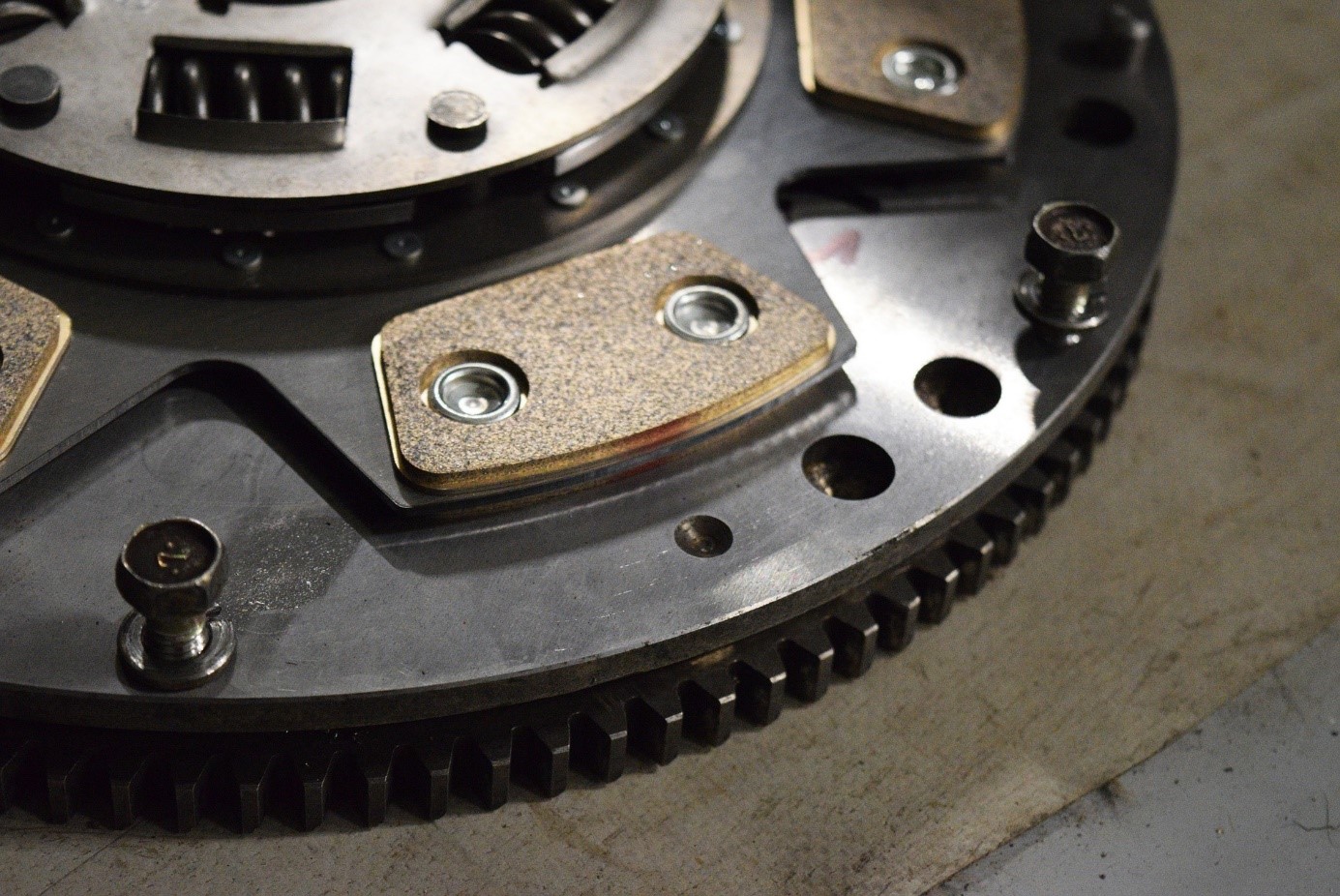
Flywheel with clutch plate
Pressure Plate
The pressure plate sits on top of the clutch plate. It is bolted to the flywheel and is therefore in direct connection with the engine, always rotating at the same RPM as the engine and flywheel. The only component that doesn't always rotate with the engine is the clutch plate because it is in direct connection with the gearbox.
As the name suggests, the pressure plate ensures that under normal circumstances, a large pressure is exerted on the clutch plate. This 'sandwiches' the clutch plate between the flywheel and the pressure plate to create a solid connection and transfer power to the gearbox.

Pressure plate with the fingers in black
When the clutch is depressed (slave cylinder), the release bearing will press against the fingers (black triangles in the photo) of the pressure plate, which will then disengage the connection.
Master Cylinder/Slave Cylinder
The master cylinder is bolted against the firewall and is in direct connection with the clutch pedal. As soon as the clutch pedal is pressed, pressure builds up in the line to the slave cylinder, and the brake fluid/clutch fluid wants to move.

Gearbox shaft with the release bearing on it
The slave cylinder is mounted on or in the gearbox. It ensures that the forces from the clutch pedal are converted into movement of the release bearing. The release bearing (shown with the blue plastic) will now exert force on the pressure plate, which ensures that the connection between the gearbox and the engine is disengaged.
Do you choose a standard clutch or a racing clutch (4-6 puck)?
Before replacing a clutch, the choice must be made as to which clutch will be reinstalled. In the case of a standard car, the choice is usually quickly made, and an original/standard clutch will be installed.
For cars with products from LucaCarMods.com, this will be different; these often have more power than original or are driven more sportily. For these drivers, we offer a Competition Clutch Stage 3 and a Stage 4. These clutches are more than suitable for drifting or for cars that have had a turbo installed afterward.
The material of these clutches has a different, more expensive composition, which makes them more resistant to heat and less prone to slipping.
Competition Clutch Stage 3
The manufacturer indicates that this clutch is suitable for a power increase of 150%. On the Mazda MX-5s with turbos that we build, this is the most commonly used clutch. The pedal feels almost like original, the clutch engages non-aggressively, and it has proven itself on Mazda MX-5s with 280-300HP. Originally, a Mazda MX-5 has between 90 and 140hp.
Competition Clutch Stage 4
If you drift very often, have over 300hp (in a Mazda MX-5), or want a clutch that engages more aggressively, the Competition Clutch Stage 4 is the best choice. This is suitable for power increases of 150-200% and will engage much more aggressively compared to the original clutch. My personal experience is that the Stage 4 is still perfectly drivable as a daily car in terms of engagement, but stop-and-go traffic is less pleasant.
Lifespan of a racing clutch
The lifespan of a Stage 3 or 4 clutch heavily depends on its intended use. With normal use, it can last as long as or longer than an original clutch. With modified use such as drifting, drag racing, or track driving, very little can be said about the lifespan as it depends on too many factors.
Purchase advice from LucaCarMods.com
The purchase of a clutch is very personal; to help you on your way, we have provided advice based on 3 different situations.
-
Original car – no ambition for drifting or more power in the future.
A replacement clutch will suffice and will typically last 170,000km before needing to be replaced again. -
Modified power +50/75% – sporadic drifting and/or track use
You demand significantly more from the clutch due to the extra power. When track driving and especially when drifting, much more heat will be generated. An original clutch will wear out very quickly or slip immediately. A Stage 3 clutch is the perfect solution in this situation. -
Modified power +100/175% – regular drifting and/or track use
The Stage 3 clutch may struggle in certain situations with this use and power. At this power level combined with drifting, a Stage 4 clutch is a must! It can withstand even more heat and will engage much better.