
Drive-by-Wire on a Mazda MX-5 NA/NB: benefits and ECU functions
The Mazda MX-5 NA and NB came standard with a mechanical throttle cable. Simple, reliable, and exactly what you expect from a lightweight 90s roadster. For a stock car or a simple setup, there is absolutely nothing wrong with that.
However, Drive-by-Wire is becoming increasingly attractive on older MX-5s. Not because a throttle cable is bad, but because an electronic throttle gives you far more options once you start working with a modern ECU, turbo build, engine swap, or automatic conversion.
With Drive-by-Wire, there is no longer a direct cable between your accelerator pedal and the throttle body. The accelerator pedal sends an electrical signal to the ECU. The ECU then controls the electronic throttle body. This allows the ECU to determine much more precisely how the engine responds to your pedal input.
That may sound less pure than a throttle cable, but in practice, it is mainly about control. You can make the engine respond more smoothly at low speeds, sharpen it up when you want, control the idle better, and use features that are much harder or less refined to achieve with a standard throttle cable.
Why would you build DBW on an MX-5?
The biggest gain is not in peak power. A Drive-by-Wire throttle body does not automatically make your engine more powerful. The gains are mainly in drivability, tuning options, and additional features.
With a mechanical throttle cable, the relationship between pedal position and throttle body position is largely determined mechanically. The further you press the pedal, the further you open the throttle body. Simple and direct, but also limited.
With DBW, the ECU determines what happens. For example, a small amount of pedal input can be gradually built up for road use, while the same engine in a different map responds much more sharply. The ECU can also intervene with idle control, launch control, traction control, cruise control, or during the shift points of a modern automatic.
For a stock MX-5, that may not be necessary. For a modified MX-5, it can be very interesting.

Better idle control
One of the most practical advantages of DBW is idle control. In an original MX-5, idle is controlled via an idle valve and air bypass. That works fine as long as everything remains fairly stock.
With modified engines, that can become more difficult. Think of different camshafts, turbos, ITBs, engine swaps, or a standalone ECU. In those cases, you want the ECU to be able to control exactly how much air the engine receives.
With an electronic throttle body, the ECU can use the throttle body itself for idle control. You do not always need a separate PWM or stepper motor idle valve. With the ME442 or an ECUMaster Black, the DBW throttle body can also be used to control idle.
This makes DBW particularly interesting for builds where you want a clean cold start, a stable idle speed, and a smooth transition to partial throttle.
Throttle pedal mapping
Another major reason to use DBW is throttle pedal mapping. You can determine how the engine responds to the pedal position.
This can be very pleasant in a turbo build. An MX-5 with a lot of torque or a fast-spooling turbo can respond quite sharply at the bottom end. With DBW, you can make the initial pedal movement smoother, so the car remains more controllable in corners, on wet roads, or during normal street use.
At the top end, you can still open the throttle body fully. So you are not necessarily sacrificing power, but you are making the way that power is delivered more controllable.
The difference lies mainly in the throttle pedal curve; by default, this is linear with a mechanical throttle body. With high power or aggressive engines, a progressive curve may be desirable.
For street use, you can create a smoother map. For sporty driving, you can use a more direct map. Depending on the ECU and setup, you can combine this with map switching, boost control, or other motorsport features.
MaxxECU
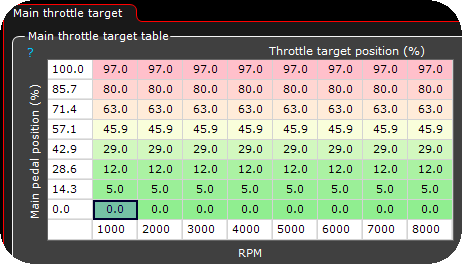
Above you can see an example of MaxxECU, with the throttle pedal position on the left and RPM at the bottom. This is how you can set what the throttle body position should be based on throttle pedal position and RPM.
This allows you to make the throttle pedal respond smoothly at low RPM and more aggressively at higher RPM.

In the MEITE software of the ME442, you set the actual throttle pedal position on the left and what should be sent to the throttle body on the right. This shows that in this example, a progressive curve is set up to 50% throttle pedal input. This provides smooth driving behavior in traffic jams or when pulling away.
Cruise control
With a throttle cable, you need a separate actuator to operate the throttle body mechanically. With DBW, the ECU can control the throttle body itself, provided the ECU supports cruise control and the correct inputs are present.
Not every ECU supports this in the same way. With MaxxECU, cruise control with E-throttle is officially documented, with inputs for set, abort, accelerate, decelerate, resume, and brake pedal status, among others.
The MaxxECU and ECUMaster Black offer the option to configure cruise control. This is no longer possible with the ME442.
MaxxECU cruise control settings
Throttle blip and rev matching
When downshifting, you sometimes want the engine to briefly rev a little to match the RPM. This is what we call throttle blip or rev matching.
In a manual car, this is mainly interesting for sequential gearboxes, paddle shift setups, or very specific motorsport applications. With a modern automatic conversion, it becomes much more relevant.
A ZF 8HP transmission works best when the engine ECU and transmission control work well together. During upshifting, temporary torque reduction may be necessary. During downshifting, rev matching or a throttle blip can help make the transition smoother.
That is why DBW is an important part of the complete setup for our own 8HP MX-5 swap development. DBW gives the ECU much more control over what the engine does during shift points.
With MaxxECU, throttle blip is documented as a motorsport feature, and E-throttle is mentioned as the recommended way to provide extra air during the blip. MaxxECU also supports GEN1 ZF 8HP 45/70/90 transmissions.
ECUMaster EMU Black also supports DBW blip, gear cut, launch control, traction control, and rev matching features, depending on the further setup.
Which ECU is suitable for DBW on an MX-5?
The right ECU depends on what you want to do with the car. A simple naturally aspirated street MX-5 has different requirements than a turbo car with DBW, boost-by-gear, and an 8HP conversion.
For many MX-5 builds, the ME442 is interesting, especially if you are already in the Motorsport Electronics ecosystem. The ME442 builds on the ME221, but adds onboard wideband, logging, CAN, and Drive-by-Wire support, among other things.
For an MX-5 with a turbo or performance setup, these ME442 features are particularly interesting:
-
Drive-by-Wire support
-
idle control via DBW
-
pedal and throttle body calibration
-
launch control
-
boost control and boost-by-gear
-
knock control
-
CAN expansion
-
onboard wideband with ME442
-
onboard logging with ME442
-
traction control, depending on sensors and configuration
The ME221 remains a good ECU for many MX-5 applications, but not if DBW is the main reason for the conversion. Also, it is more cost-effective to use an ME442 due to the onboard wideband and included sensor.
ECUMaster EMU Black is also a strong option when you want more motorsport features or are building a setup where DBW, launch control, traction control, gear cut, blip, and rev matching are important. The EMU Black supports engines with electronic throttle bodies and has DBW strategies with plausibility/fault checking.
MaxxECU is particularly interesting when you are moving towards advanced transmission control or 8HP integration. However, you must pay close attention to which 8HP generation you are using. MaxxECU lists support for GEN1 ZF 8HP 45/70/90, not automatically for all later variants.
What hardware do you need?
For a DBW conversion, you basically need three things: an electronic throttle body, an electronic accelerator pedal, and an ECU that can safely control the throttle body.
For the MX-5 NA/NB, we use a Mazda MX-5 NC DBW throttle body. For this, we have developed an adapter with which the NC throttle body can be neatly mounted on an NA/NB. The goal is not only that it fits, but especially that the throttle body is neatly aligned. With many universal solutions, you see that an electronic throttle body is slightly crooked due to the bolt pattern, with our 2-piece design this is not the case.

For the accelerator pedal, we use an electronic pedal from a 2008-2015 Honda Jazz. For this, we have developed an adapter with which the pedal can be neatly mounted in the MX-5 NA/NB. This gives you a neat mechanical basis to build DBW in an NA/NB. The wiring and ECU settings remain dependent on the chosen ECU and setup.

Is DBW necessary for every MX-5?
No. For a stock MX-5 or a simple naturally aspirated setup, a throttle cable is still perfectly fine. Sometimes simple is just better.
DBW becomes particularly interesting as soon as you ask more of the ECU. Think of a turbo setup where you want to properly dose pedal response and boost, a car where you want to add cruise control, a build with launch control or traction control, or a modern automatic conversion where the engine and gearbox need to work together.
So it is not a mandatory upgrade for every MX-5. It is, however, an upgrade that opens many doors when you want to make the car more modern, more adjustable, or technically more comprehensive.
What should you pay attention to?
DBW must be properly connected and calibrated. The ECU must correctly recognize the accelerator pedal and the throttle body. The pedal sensors, throttle body sensors, PID control, and safety checks must be set up correctly.

Therefore, do not see it as a “just quickly connect it” upgrade. We can solve the mechanical mounting neatly with adapters, but the electrical connection and adjustment must be correct. This applies especially to cars used on the street. Always consult a tuner for the adjustment of DBW if you have doubts about your own abilities.
Conclusion
Drive-by-Wire does not automatically make a Mazda MX-5 NA/NB better. A good throttle cable still drives perfectly fine. But as soon as you are working with modern ECU features, turbo, cruise control, traction control, or an 8HP conversion, DBW suddenly becomes very interesting.
You get more control over idle, throttle pedal response, and torque build-up. You can use features that are difficult or less refined with a throttle cable. And with modern transmissions, DBW gives the ECU the opportunity to work much better with the gearbox.
For a simple MX-5, it may be superfluous. For a modern MX-5 build, it is often precisely a logical step.
Frequently asked questions about Drive-by-Wire on a Mazda MX-5
What is Drive-by-Wire?
Drive-by-Wire means that the throttle body is electronically controlled by the ECU. The accelerator pedal sends an electrical signal, after which the ECU determines how far the throttle body opens.
Why would I use DBW on a Mazda MX-5 NA/NB?
Mainly because of additional ECU features and better control. Think of better idle control, throttle pedal mapping, launch control, traction control, cruise control, and better cooperation with modern automatic conversions.
Is DBW better than a throttle cable?
Not always. For a stock MX-5, a throttle cable is perfectly fine. DBW becomes particularly interesting when you want to use more features via the ECU.
Can I adjust my throttle pedal response with DBW?
Yes, with a suitable ECU you can adjust the relationship between pedal position and throttle body opening. This allows you to make the car smoother for street use or more direct for sporty driving.
Is the ME442 suitable for Drive-by-Wire?
Yes, the right ME442 version can be suitable for DBW. However, always check if your ME442 is equipped with the DBW chip, as only the first generations have a preparation for this.
Can I use cruise control with DBW?
That depends on the ECU. DBW makes cruise control technically logical, but the ECU must support this feature. Always check this per ECU and software version.
Why is DBW important with a ZF 8HP swap?
A ZF 8HP works best when the engine ECU and transmission control work well together. DBW helps with features such as torque reduction, throttle blip, and rev matching.
What parts do I need for a DBW conversion?
- LCM - Mazda MX-5 NA/NB DBW Accelerator Pedal Adapter Honda Jazz
- Electronic accelerator pedal from a 2nd generation Honda Jazz 2008-2015
- LCM - Drive By Wire Throttle Body Adapter MX-5 NA/NB
- Mazda MX-5 NC drive-by-wire throttle body (note: only the throttle body without the O-ring groove is suitable)


